The Thirsty River
A story of the importance of the river Kaveri and a song that gives her a voice.

The city of Bangalore has gone through a very eclectic list of descriptors. From the lazy “Pensioner’s Paradise” in the 70’s and 80’s where people wore sweaters and monkey caps while walking down the Boulevard on MG Road to catch an English film at Plaza Theater to the diminishing title of “Garden City” with multiple trees and benches in parks have served as archives for lovers who felt the need to etch their names connected with an arrow pierced heart. From being called India’s “Silicon Valley” from the tech boom to being ridiculed for the doomed Silk Board traffic that was a direct effect of the influx of ambitious techies from all over the country. From being the “Pub Capital” of the country to a decade of bizarre legislation that forced everyone to wrap up at establishments half an hour before even Cinderella (A measure taken to reduce drunken driving. Turns out everyone just started drinking earlier). The last example is indeed interesting on many levels as Bangalore was truly equipped to have a nightlife very early on.

Back in August 1905, Bangalore became the first city in Asia to have electric street lights. Turns out Bengal used electricity and switched on a lamp many years before but the area where current day KR Market stands in Bangalore is the first public area that was lit up through electricity rather than oil lamps. Science starter kits these days make electricity seem trivial but that street lamp in 1905 received electricity took a very interesting journey.
Before “Rocking Star” Yash announced his presence as Rocky Bhai in the K.G.F. film franchise, the Kolar Gold Fields came into the spotlight after an Irish soldier named Micheal Lavelle gained mining rights in the area. The amount of gold found got both the British Empire and the Mysore Kingdom very excited and while the existing manual labor and machinery yielded results, they wanted to dig deeper. The only way forward (deeper?) was to use electric powered drills and machines. Thus, K.G.F. got powered. Turns out there was an excess in the electricity generated for the mines so that very excess was leveraged to light up Bangalore city!
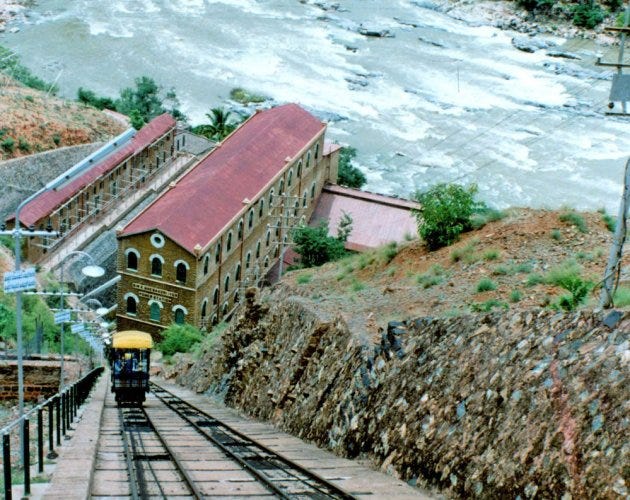
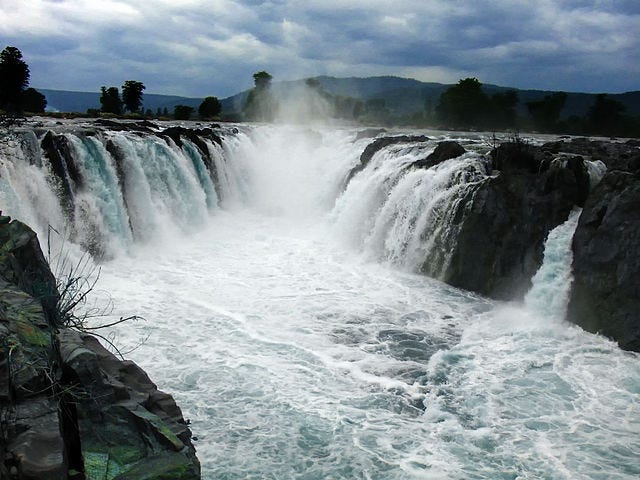
K.G.F. drew electricity from one of India’s first ever hydro electric stations in Shivanasamudra, Karnataka which is a little more than 200km on modern day roads from K.G.F. and around 130km from Bangalore. The waterfalls at Shivanasamudra stands at a 90m height at which the River Kaveri makes a deep plunge in her course. The River Kaveri has a high significance for the majority of the Deccan Plateau for various reasons. A positive reason is because of all the scenic tourist spots that come out of it. Starting from the origin of the river in Talacauvery in Kodagu (Coorg) down the road to the astute town of Bhagamandala before enthralling wildlife enthusiasts at Nagarhole National Park to name a few attractions.
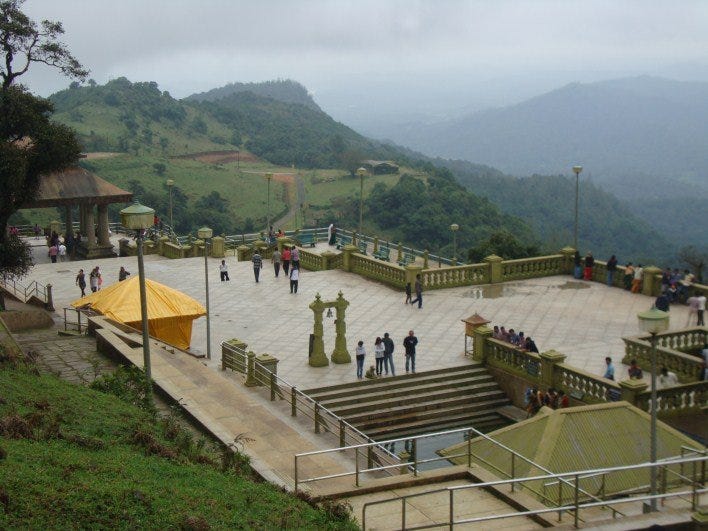
The Shivasamudra Falls and the natural bird sanctuary at Ranganathittu come next as the river goes through the plateau. As the plateau gives way to the plains in Tamil Nadu, the Kaveri meanders further south to the Hogenakkal Falls before a pitstop at the Mettur Dam and approach the ancient temple town of Thanjavur after transiting Erode and Thiruchirapalli before finally reaching the Bay of Bengal.
The distribution of the Kaveri however, has been a subject of dispute for ages as different kingdoms and governments have drawn state lines in the area. From a time when the Mysore kingdom clashed with the Madras Presidency of the British Empire to post partition India where the states drew new lines to create Karnataka and Tamil Nadu, there has always been a fight on who gets the water. This is probably a fight that will only worsen as the years go by. As someone who grew up in Karnataka in the 2000s, I woke up to find a Kaveri related headline in the Deccan Herald on most days. While the water dried up and the narratives stagnated, a folk rock band named Swarathma released their song, ‘Pyaasi’ (Thirsty), a lament sung from the perspective of the River Kaveri while everyone continued to fight over her and just like that, we have a song to talk about.
Like the Kaveri, my writing meanders and splits into tributaries. This delightful diversion is about how I discovered Swarathma.
The first time I heard Swarathma was in the mid 2000s. My parents had creatively “cut our cable” (but really, mom just hid the cable and made it magically appear like that one ruppee coin the tooth fairy left under my pillow) so the radio was the primary source of entertainment. This was a great era of radio in Bangalore. Radio City FM 91 (now 91.1) got it right on so many levels. I’m going to gush about them for a second. They had amazing RJs to start, Darius Sunawala had a voice that made every mother want to adopt him even though half the population couldn’t pronounce Darius properly. Vasanthi Hariprakash ran the morning show with such energy, one would think Vidya Balan’s character in Lage Raho Munnabhai would be based on her. She only accelerated the smiles her predecessor Sunaina Lall brought to the thousands of Bangaloreans who were stuck in traffic. The Sunday morning show called Chow Chow Bath (a colloquial term for a serving of Kesari Bath and Kara Bath at the Bangalore darshinis) played retro Kannada songs which my father would enjoy with us when we were on the way to some tuition class.
Things got exciting when Radio City began to play English music after 9pm in a show hosted by Rohit Barker who educated me on what songs were cool so I could be relevant in school. His show had a song request segment and I sent a text at 9:55pm to play Lose Yourself by Eminem. It was time for me to sleep so my dear mother herded me to bed. My phone rang but I was too scared to leave my bed because that would indicate I was still awake. My mother picked up the call and I only heard her mumble something. She then came to my bed to speak to me obviously knowing I was wide awake. Turns out Rohit Barker got my text and wanted to put me on air to speak about why I wanted that song. Instead, he got to learn from my mother that I had gone to sleep so tough luck. Mom and I still reminisce that experience. Radio City’s success allowed them to come up with a new show called Radio City Live, a show that invited local bands to the studio and they performed live for all the listeners. The host of the show was RJ Rohit Jeykaran and he did a great job interviewing every band that came by. Some bands I can remember from that show are Galeej Gurus, Thermal and a Quarter, Lounge Piranha and of course, Swarathma.
I always listened to Radio City Live but Swarathma hit differently. They opened with their song “Ee Bhoomi” (This Earth) which was in Kannada and I can safely say that no one had heard something like that before. That was the first time I heard a Kannada rock song. I understood the lyrics but the energy transcended it. This was still a phase where social media was still quite nascent so I couldn’t figure out who these guys were, but I was excited. They released a lot of music after that. Ee Bhoomi is still a cult hit but songs like “Yeshu, Allah aur Krishna” and “Koorane” are memorable hits. The band itself comprised of a diverse variety of members.
Be it drummer/percussionist Montry Manuel, who is basically known by anyone in Bangalore who ever played in a band and take pride in knowing him or KJ Pavan Kumar, a percussionist from Mysore who found his calling to music despite the multiple two wheeler rides that involved balancing amps and instruments to get to a gig. Or we can talk about bassist Jishnu Dasgupta who got his MBA from XLRI Jamshedpur and also leveraged his NIT engineering degree with a job at TCS but still chose to be the Bangla brother singing backing vocals in Kannada to another techie Sanjeev Nayak who left his career at Mindtree to play the violin for the band but still found a way to balance tech and art as a VP at tech firm even today. Members like Varun Murali, the lead guitarist, inspire both tech proficient producers and music teachers in schools who are all rockstars (That being said, please go to Toscano in UB City, Bangalore on a weekend evening and ask the balding man with a mustache to sing anything Dire Straits. My music teacher Mr. Trevor Claremont will play his heart out). But that brings us to Mr. Vasu Dixit, the lead vocalist.
It is very difficult to introduce this man as he is a free soul that can’t fit into any category. His long beard, fuzzy hair and colorful costumes are only subdued by his strong vocals that stun your senses to perceive everything else that is going on. While he has success to his own merit, I would like to share that he is the brother of Raghu Dixit whom the rest of the world may know from the Train Song in Gully Boy or other hits like Mysore Se Aayi and Hey Bhagwan. Raghu Dixit’s Ambar melts your heart but we need to talk about Vasu’s music here.
When Swarathma got featured on the MTV show The Dewarists, I only loved them more. Here, we finally get to speak about the origin story of Pyaasi. The episode in set in Mysore and a there is a shot of a train that goes past a river. It then cuts to Vasu Dixit who shares how it was in a train journey the subject of water allocation was debated as always. There was an old lady who was taking part in the conversation but had reached her stop. However, before leaving she urged Dixit to ponder on how the Kaveri felt about everything. It is difficult to ask a river how she felt about politics, of land that seemed the same to her but had different owners as years past and pulled her in different directions. It is difficult to ask a river what she felt about just being stopped at different places for what seems like an indefinite time through dams and reservoirs.
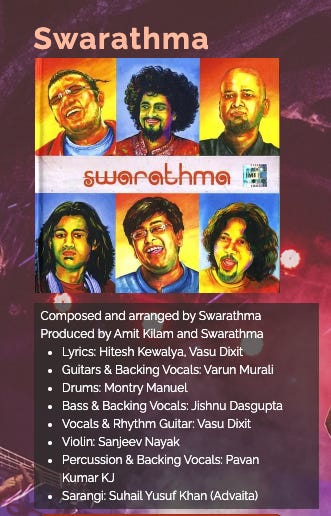
A very creative and informative visual shared by the band tells us a lot about all the people who made this song come to life. Starting with the Sarangi played by Suhail Yusuf Khan from the band Advaita. Apart from sharing the name of one of my best friend’s company, the band Advaita has carved their space in the universe of Indian music as a leader in seamlessly blending classical with modern. In the same show Dewarists, Advaita collaborates with another brilliant musical mind, Sahej Bakshi aka Dualist Enquiry. It is important to mention Dualist Enquiry because he has also worked with Swarathma on a dubstep-ish remix of their song Naane Daari. Sanjeev Nayak’s violins in this song is the star that just makes you bounce to the track.
The song Pyaasi is written in Hindi by Vasu Dixit and Hitesh Kewalya. The latter went on to become a director and made the film Shubhaarambh Mangal Zyaada Saavdhan. One may wonder if he sipped chai between takes and told Ayushmann Khurrana about that time he sat with these Mysore boys and wrote about the Kaveri! Finally, the song is co-produced by Swarathma and Amit Kilam. To the uninitiated, Mr. Kilam is also the drummer of the band Indian Ocean and his drum roll in their song Bandeh is almost as iconic as Phil Collin’s In The Air Tonight.
With that diversion, we come back to the Kaveri and how she tells us her story through Pyaasi. The very first line, “Pyaasi hoon main, tumko pile ke” (I have grown thirsty by giving you water) gives us context and does well to punch us with guilt. The song then continues to lament the plight of the river with the lines, “Kahan se aayee, Khan hai jaana. Kiski boli bolna hai ab?” (Where have I come from? Where have I ended up? Whose language do I speak now?) This was written to explain how the river starts in Karnataka and ends in Tamil Nadu so the river also goes through a bit of an identity crisis as she progresses. But we can extend this metaphor even for the geographical land forms starting from the hills of Kodagu to the Deccan Plateau through Mysore as well as the plains of Erode and Thanjavur. Again, it is magical how two lines can pack in so much information that can trigger immense thought and emotion. As always, I don’t want this to be a lyrical breakdown but the other line which I would like to share is “Megha tu chi laut ja re, Ghar samundar bhool gayi hoon” (Clouds, you can go back, I have forgotten my home, the ocean). This line amplifies the defeat expressed by the river on how she has given up on fulfilling her purpose.
It is obvious that we must conserve water and this post is not a medium to advocate any politics with regards to the Kaveri issue. But the goal is to shed more perspective on the topic. To know what the river might feel and also the significance of water in an area you grew up. Bangalore gained electricity because of the Kaveri and today it is home to hundreds of tech start ups and multinationals alike. Many factors have led to this, but we should take a moment here to appreciate the role of the Kaveri as well.